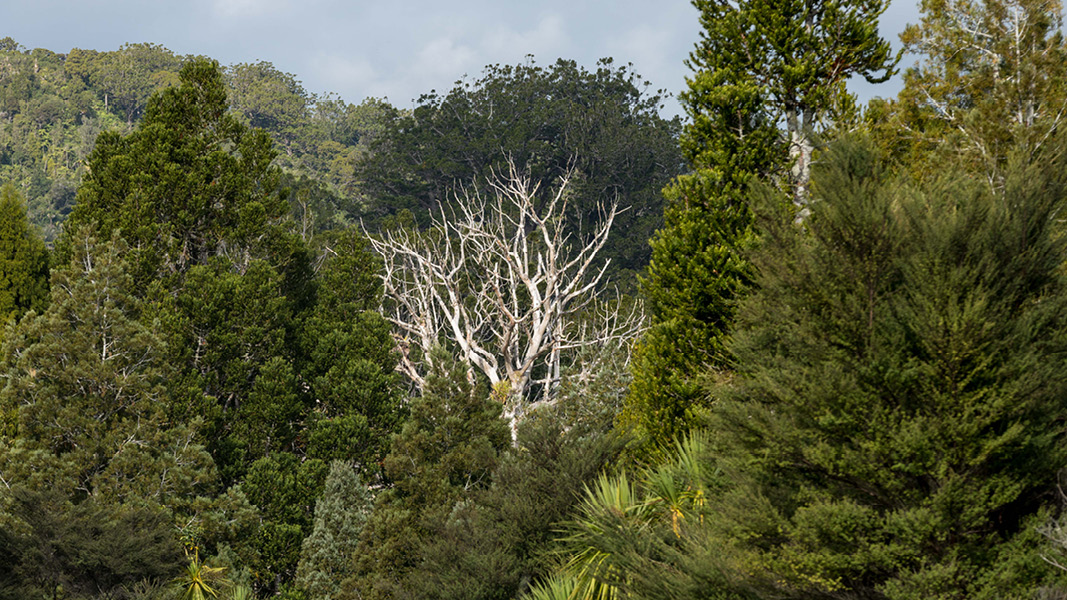
Initially PA was a new pest species that brought a whole bunch of questions with it. What have we learnt over the last two decades?
In the early 2000s, Kauri were observed to be dying in the Waitākere Ranges. Authorities were alerted and an investigation commenced. Over the last 20 years, research has taught us a lot about the pathogen Phytophthora agathidicida (PA), which is causing this disease. This knowledge has helped inform management and mitigate the impact of this pathogen. It has also provided hope in our ability to protect Kauri.
Initially though, PA was a new pest species that brought a whole bunch of questions with it. What was causing these symptoms? Was it in all of Kauri lands? Were there ways to treat the trees?
What was causing Kauri to become sick and were other species at risk?
We now know that Phytophthora agathidicida is what is causing disease in Kauri. Phytophthora (which translates as ‘plant destroyer’) are pathogens that cause a range of diseases in plants. There are hundreds of species across the world. These species are diverse, and some Phytophthora species will only infect certain plants, while others aren’t picky in what they’ll infect. For example, in Australia Phytophthora cinnamomi poses a significant threat to the local environment due to its generalist nature.
While PA is a significant threat to the taonga species Kauri, one advantage we have in stopping PA spread is that it doesn’t impact other native species in the ngahere (forest) in the same devastating way.
Management is also made easier because we know that PA is the only Phytophthora species having this impact on Kauri in the ngahere.
A study in 2014 investigated the impacts of four Phytophthora species on Kauri. The results of this suggested that while PA is a very aggressive pathogen to Kauri, the others had a much weaker effect on the plants.
Understanding what is causing this disease and knowing it is restricted to one pathogen and one host plant makes management much more achievable.
Is PA in all of Kauri lands?
There has been extensive surveillance and monitoring across Kauri lands since the discovery of PA in 2006. This surveillance has been strengthened by Tiakina Kauri investing in training people and creating a collection of tools to help groups on the ground survey and care for their ngahere in a scientifically robust way.
The result of this mahi (work) is that we are building a clearer idea of where PA is and isn’t in Aotearoa New Zealand. This knowledge is vital as PA is spread via soil movement, so PA-free Kauri stands are at risk if infected soil is brought into the area. Without soil movement via people, animals and vehicles, the spread of PA is naturally very slow. This gives us valuable time to continue looking into solutions. That’s why it is so important that we all take action to stop the PA pathogen from spreading.
Are there ways to slow the spread?
While there is still no cure for PA infected trees, we have learnt a lot about slowing the spread of PA in and around infected trees. Research has highlighted the effectiveness of phosphite treatments for improving tree health, reducing the amount of PA in the tree and the soil and only needing treatment every few years.
Treating trees with phosphite can also be used as a preventative barrier to protect trees of significance. Just like how you spread bacteria and viruses when you sneeze or cough, sick trees shed more PA back into the environment. If the trees around them are treated and are at lower risk of contracting or spreading PA, then this reduces the risk of these trees getting sick without having to treat them. While we have a good understanding of the dose of phosphite needed in younger trees, it is still an unknown with the large mature trees, although recent research is close to finding the answers.
Science shows that managing the risk of PA movement through actions such as good hygiene in the ngahere, staying away from Kauri roots and on the tracks and reducing soil movement are vital ways to keep these trees safe.
If you are interested in learning more about what science has shown about Kauri and PA, we have recently published 10 key facts in collaboration with Auckland Council and the Department of Conservation.
Bioprotection Aotearoa has also recently shared a podcast about the early days of Kauri protection hosted by Professor Amanda Black, Professor Peter Dearden and Dr Nick Waipara.
“As long as there are people that care, there is hope.” – Professor Amanda Black